The material
What asbestos is, and why Australian homes still have it
Risks in the home after you already know what the fibre is. The short definition lives at /what-is-asbestos/.
- National ban
- 31 Dec 2003
- Historic product types
- 3,000+
- Typical housing window
- Pre-1990
- Of fibre exposure
- No safe level
Asbestos is a group of naturally occurring silicate mineral fibres that were used in more than 3,000 products in Australia. Breathing the fibres can cause asbestosis, lung cancer and mesothelioma. A national ban took effect on 31 December 2003. If you find suspected asbestos, engage a licensed asbestos professional — do not remove it yourself.
Definition
Asbestos-containing material (ACM). Any material or product that contains asbestos. In Australian houses this is usually asbestos-cement sheet (fibro), vinyl tiles, insulation, or textured coatings — confirmed only by laboratory analysis.
After the definition: the house, not the mineral
You already have the short definition at what is asbestos. This page is the next conversation: why that fibre still sits in Australian homes, and what that means for anyone who lives there. It is not a second copy of the mineral names. It is the household risk story.
Safe Work Australia puts the current problem plainly: despite the ban, thousands of buildings and plant still contain asbestos. The Asbestos Safety and Eradication Agency publishes householder guidance for the same reason. Read those pages in their words. This domain is educational. It does not issue licences, prices, or clearance certificates.
The short history that still sits in the walls
Australia was a heavy user of asbestos. Cement sheet — sold under names many tradies still recognise, such as Super Six, Hardiflex, Hardiplank, Versilux and Tilux — was cheap, light and everywhere from the 1940s through the 1980s. Queensland’s public diagram of a 1970s house still lists those names, plus Zelimite, as a map of suspicion. Names are clues. They are not certificates.
Manufacturing of many products wound down in the 1980s. The complete prohibition on new asbestos work arrived on 31 December 2003. If ASEA’s householder booklet had to ask one screening question, it would be the one this site repeats: was the house built or renovated before 1990? If yes, assume some asbestos-containing material may be present and plan any work accordingly.
A 1920s stone front with a 1970s sleep-out is two different conversations. Age of the fabric you are about to disturb matters more than the year on the title. Prestige postcodes do not cancel fibro eaves.
Health, without medical theatre
Inhaled fibres can cause asbestosis, lung cancer and mesothelioma. Latency can be decades. There is no known safe level of exposure. That is why this site refuses DIY removal advice even when a state page describes a small-quantity exception for 10 m² or less of non-friable ACM. We mention that figure only to reject it as a weekend method. The ACT requires a licence for any removal.
We are not clinicians. If you have been exposed, talk to your GP and read the health pages on your state asbestos site. Do not use this page as a diagnosis. Do not use a latency story as a reason to “get it all out this Saturday”. Removal is licensed work. See asbestos removal.
How risk actually appears in a dwelling
The fibre is not a haunting. Risk rises when someone creates dust.
Typical household pathways, none of which this site will turn into a tutorial:
- A bathroom strip-out that prises tiles off cement sheet. Read asbestos in the bathroom.
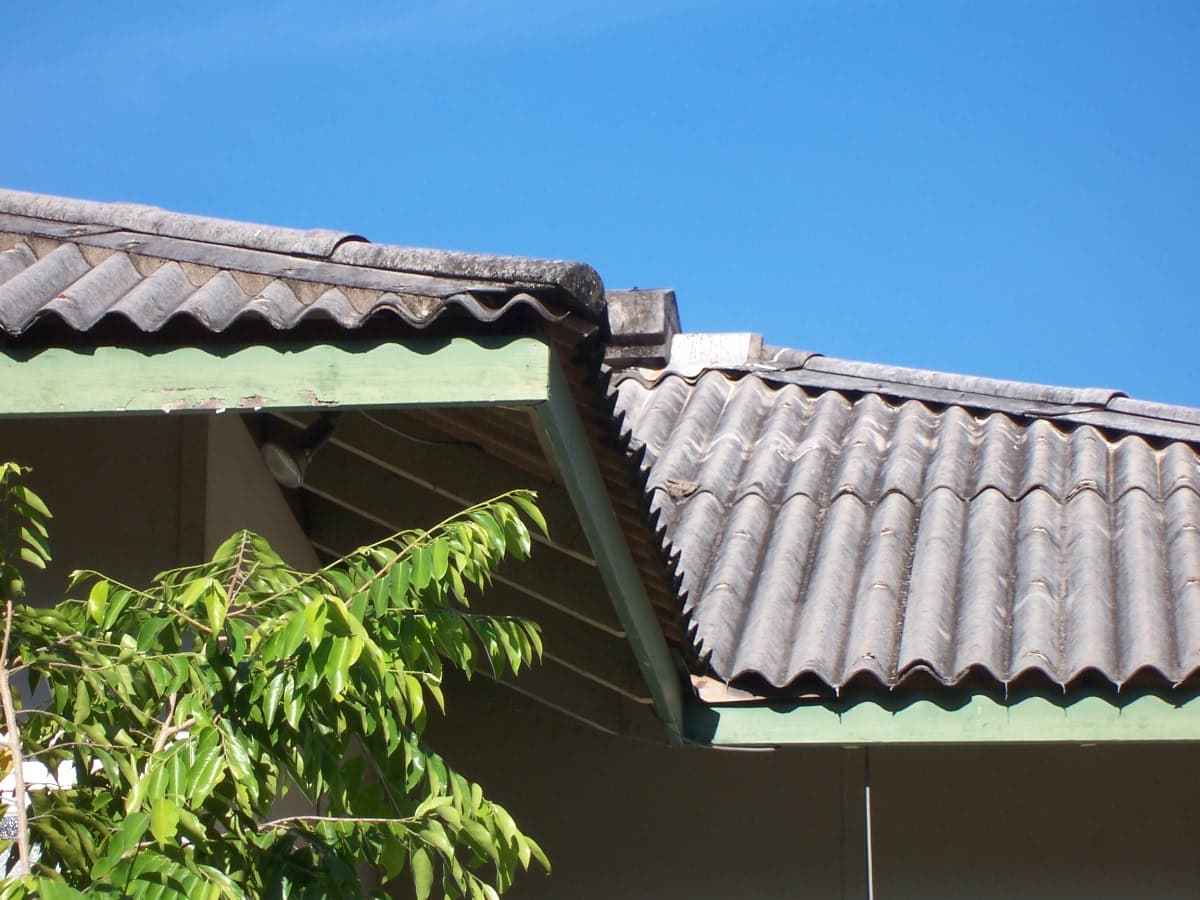
- A “quick clean” of eaves or a Super Six roof with a water blaster. High-pressure water shreds bonded surfaces. See asbestos roof removal and walls and eaves.
- A fence paling snapped to “see if it is fibro”. Broken edges and the soil at the base become the next problem. See asbestos fence removal.
- Sanding vinyl tiles or old adhesive before a new floor. Vinyl and felt backing in pre-1990 houses can be ACM.
- Drilling a camera, sensor or shelf into a painted soffit or wet-area wall “just in case it is only plaster”.
- A household vacuum over debris after something has already broken.
Intact bonded sheet that nobody is cutting is a different conversation from a pile of crumbs on the laundry floor. Only a licensed professional should make that call. Do not disturb material to “check”. The evergreen guide is is asbestos safe if undisturbed.
Friable and non-friable, in household language
Friable ACM can be crumbled by hand. Fibres release easily. Pipe lagging, some insulation, and sheet that fire or severe weather has destroyed sit here. Only a Class A licensed removalist should handle it.
Non-friable (bonded) ACM holds fibres in cement or vinyl. Intact sheet is usually lower risk until someone cuts it, drops it, sands it, or hits it with a water blaster. Weathered roofing and broken fence palings sit in a grey zone — still a licensed job.
Encapsulation or leaving stable ACM in place can be a control when removal is not reasonably practicable. That decision belongs to a competent person. Painting over a broken paling is not encapsulation.
What the ban did not do
The ban stopped new manufacture, import and use. It did not require every homeowner to strip a sound Super Six roof the next morning. Existing ACM can remain if it is stable and left alone. “Stable” is a competent-person call, not a Facebook group call.
The ban also did not make visual identification reliable. Paint, moisture and lookalike cement products erase folklore. NSW’s asbestos site states you cannot tell by looking. That sentence is why asbestos testing exists: a NATA-accredited laboratory, arranged by a competent person — not a chip in a shopping bag.
Duties when the house becomes a workplace
WHS duties are not a curiosity. When you hire a contractor, part of the house becomes a workplace. The contractor must hold the right licence class for the material. You should confirm that licence with the state regulator — SafeWork NSW, WorkSafe Victoria, WHSQ, WorkSafe WA, SafeWork SA, or the equivalent. This site will not invent a directory or a licence number.
Some state pages say a homeowner may be allowed to remove less than 10 m² of non-friable asbestos in limited circumstances. Those same pages say there is no safe level of exposure and that they strongly recommend a licensed removalist. We go one step further: do not DIY. Engage a licensed asbestos professional.
Where to go next in this site
- Definition only — what is asbestos
- Room-by-room suspicion — asbestos in my home
- City housing stock, starting with the historic hub — asbestos removal Adelaide
- Questions in one list — FAQ
If you need a referral, use contact us or email [email protected]. Suburb and a description. No samples in the post.
Official reading
Compare
Friable versus non-friable
| Topic | Friable | Non-friable (bonded) |
|---|---|---|
| What it means | Can be crumbled, pulverised or reduced to powder by hand when dry. | Fibres bound in a matrix such as cement or vinyl. |
| Typical house examples | Pipe lagging, some insulation, severely weathered or fire-damaged sheet. | Fibro walls, Super Six roofs, fences, vinyl tiles, eaves. |
| Who can remove it | Class A licensed asbestos removalist only. | Class A or Class B licensed removalist. This site still says do not DIY. |
| Fibre release | High if disturbed. Treat as urgent professional work. | Lower while intact; high if cut, drilled, broken or water-blasted. |
Questions
Questions people actually ask
A group of mineral fibres used in Australian building products until the late 20th century. It is hazardous when fibres become airborne and are inhaled.
If you only remember one sentence
Leave suspected asbestos alone and engage a licensed asbestos professional. Read Safe Work Australia, then your state asbestos site.